How to stop worrying about what to write next week

It's Wednesday afternoon. You know full well that there should have been a LinkedIn post out yesterday, and that the newsletter needs to go out on Friday. You open a blank document, stare at it for a while and then close it again, because, after all, your clients are more important. That's exactly how it went last week too.
It's not that you've run out of things to say. You've got plenty to share. It's the doubt that's holding you back: What should I write about? Where should I publish it? And does it even tie in with what I want to sell right now?
I was all too familiar with that doubt myself, until I started planning my content a month in advance. Since then, it's disappeared. Not because I've become more creative – but because the decisions have already been made by the time I sit down to write.
Here's how I do it
I have one theme for the month. I break that theme down into four weeks, so each week has its own angle on the month's topic. And that weekly angle is repeated across all the platforms where I publish: in the newsletter, in my LinkedIn post and, ideally, on Instagram too.
It's all laid out in a table. The columns are simple:
- Week number
- Theme of the week
- Headline for the newsletter
- Headline for LinkedIn
- Headline for Instagram
- Value for the reader
The last column is the most important. Here, I write in a single sentence what the reader should take away from that week's content – what they can do, understand or avoid once they've read it. If I can't fill in that column, the theme isn't good enough, so I find another one.
Whether the table is in an Excel spreadsheet, a Google Sheet or on a piece of paper next to the keyboard is irrelevant. I've seen all three work. The point isn't the tool, but that the decisions have been made in advance.
The theme must highlight what you're selling
This is where many people overlook something. I don't choose the theme of the month at random – I choose it based on what I want to sell in that particular month. If there's a course with a registration deadline at the end of the month, then the month's content is about the problem that the course solves. If there's a consultation you'd like people to book, then the month's content will focus on the problems that consultation helps to solve.
It might sound calculating, but it's actually the opposite. When your content and your offer are about the same thing, the offer doesn't feel like an interruption. It feels like the natural next step for the reader who's been following along for four weeks and has gained something from every single week. You've provided value first – and then you offer more of it.
Imagine, for example, that you're an accountant and in November you'd like to sell places on a short online course on year-end accounting for start-ups. So this month's theme becomes Ready for the New Year without panic. Week 1 is about the three receipts people always seem to be missing. Week 2 is about the deductions most people forget to claim. Week 3 is about how to create a checklist tailored to your own business. Week 4 is about what happens if you're late. Four weeks, four practical things the reader can use – and a course that suddenly makes sense to buy.
The formula – step by step
Set aside an hour once a month. That's enough.
1. Choose the theme of the month. Base it on what you want to sell or what you want people to do that month. If you don't have a specific offer right now, choose the problem your customers most often come to you with.
2. Break the theme down into four weekly angles. Each week highlights one aspect of the topic. You don't need to explain everything at once – you have four weeks to cover it.
3. Summarise the value of each week in a single sentence. What can the reader do, understand or avoid after reading it? If the sentence is vague, so is the angle.
4. Write the headlines for each channel. Same angle, different packaging. The newsletter can tell the full story, the LinkedIn post gets to the point, and Instagram uses the shortest version.
5. Set the dates. When is the newsletter being sent out, when is the post going live? Now it's in the calendar and not just in the back of your mind.
6. Write one piece at a time. When you sit down to write during the week, the only thing you need to decide is how to phrase it. Everything else has already been decided.
What you get out of it
What has surprised me most isn't that I'm writing more. It's that running the business has become easier. The marketing ties in with what I'm selling. I know what's coming next week and the week after. And I spend my energy on writing well rather than on deciding what to write in the first place.
Readers notice it too. When you talk about the same topic for a month, you don't come across as repetitive – you come across as someone who knows what they're talking about. That's the sort of trust an offer can be built on.
One thing you can do today
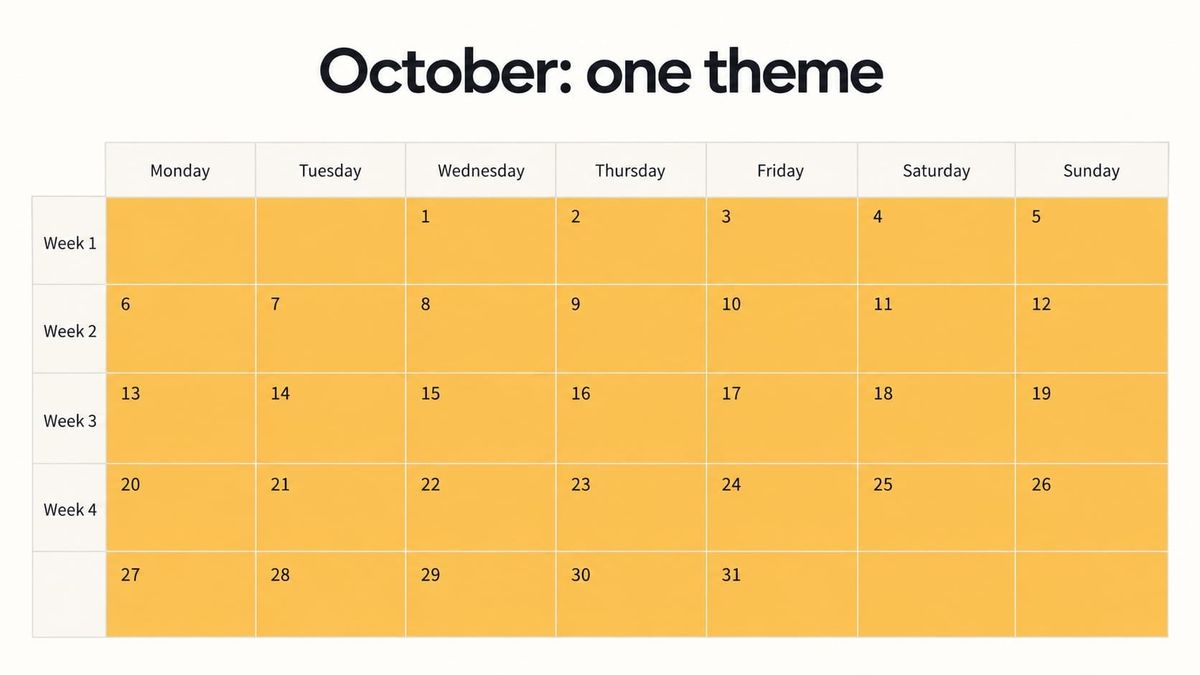
Open a blank sheet and write four lines: weeks 1, 2, 3 and 4 of October. Next to each week, write just two things – the angle for that week and the value for the reader in a single sentence. The headlines can wait. Once those four lines are filled in, you've already made the decision that usually holds you back.