How to give your writing rhythm so the reader stays hooked

I still read books on writing. After more than 25 years of writing for a living, you might think I'd be done with it, but I'm not, and I hope I never will be. Most books I read, I take a couple of good points from and then put back on the shelf. But a few are so interesting that they stick with me. Gary Provost is one of them.
I first came across him in the book 100 Ways to Improve Your Writing.
I'm not a trained journalist or anything else with 'writing' in the title. I've simply loved writing all my life, and I'll carry on doing so.
In my experience, every book on writing makes me just a little bit better and that makes me proud. Provost made me more than just a little bit better, because he put into words something I'd previously only been able to sense.
Who was Gary Provost?
Gary Provost (1944–1995) was an American author and writing teacher. For many years, he taught on writing courses and wrote about the craft behind good writing. He is best known for his 1985 book 100 Ways to Improve Your Writing — and in particular for one short paragraph on sentences, which writers still share with one another.
Five words, five words, five words
This line has five words. And so does this one. It sounds fine at first. But now it's becoming monotonous. Can you hear it stutter? It's going round in circles.
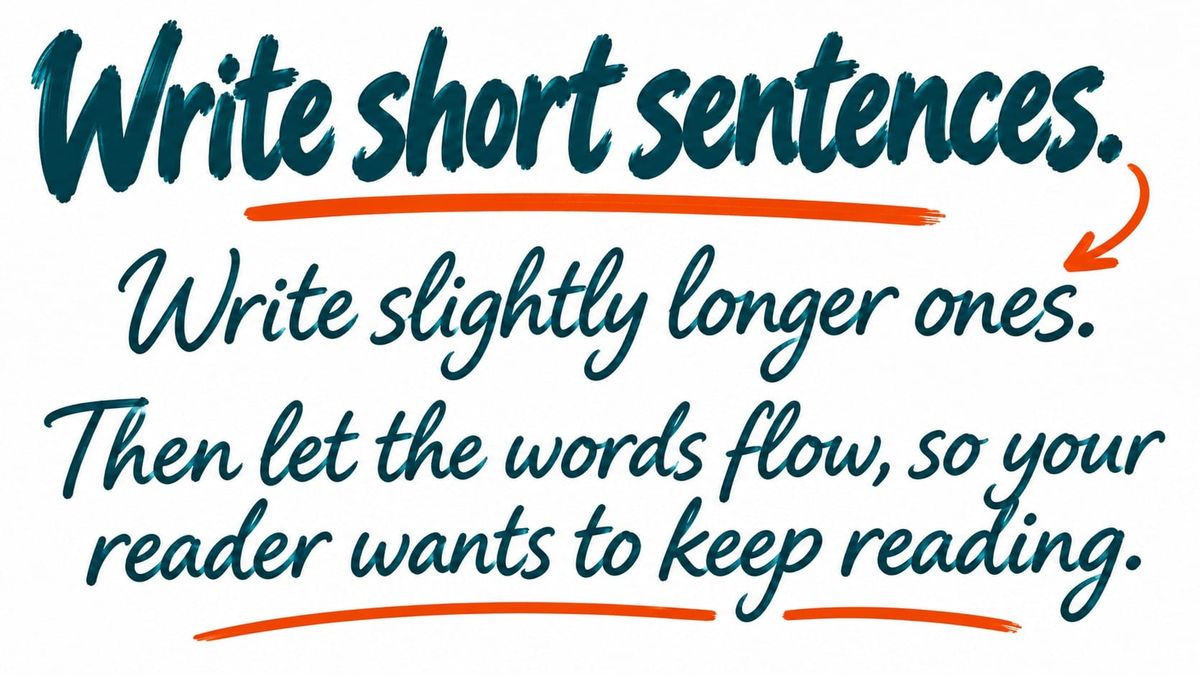
So let's change it up. Short. Then a bit longer. And then a sentence that's allowed to unfold, build up and give you time to catch your breath before it lands. Can you hear the difference?
That's Provost's technique, and that's why his passage has become so well known. He doesn't just explain the point. He lets you feel it as you read.
His point is simple: don't just write for the eye. Write for the ear. The reader hears your text in their head, even when they're reading in silence. If all the sentences are the same length, they'll lose focus — and scroll on.
Search for Gary Provost sentence length, and you'll find the whole paragraph. It's worth reading in full.
Why it matters when you write
Rhythm isn't just for show. Whether you're writing an email to a customer, sales copy, a page on your website or a social media post, it's the rhythm that carries the reader from the first line to the last, and that's where they decide whether to take action.
Many texts fall into one of two traps. Either they stumble along in short sentences, or they drag on in long ones. Both are tiresome. The reader senses it, even if they can't put their finger on why.
Imagine an accountant writing to their clients about the VAT return deadline. First version:
The VAT return deadline is approaching again. Many entrepreneurs forget it. It can be costly. We can help you with this. Write to us today.
There's nothing wrong with it. But it sounds like an answering machine. Here's the same message with rhythm:
The VAT return deadline is approaching again. And if you're like most entrepreneurs I work with, your receipts are still in a shoebox — or in a folder on your desk that you'd rather not open. That can get expensive. But it doesn't have to take more than an hour if we sort it out together. Drop me a line, and we'll find a time.
The content is almost the same. The difference is that the second version alternates between short and long sentences: a brief introduction, a long sentence that paints a picture the reader can relate to, a short, pithy point that drives the message home, and a calm conclusion. You'll read the first version. You'll hear the second.
Rhythm is a form of respect
As I see it, Provost's advice is about taking the reader seriously. When you vary your sentences, you make it easier for them to follow, and you show that you've thought about how the text feels to read — not just what it's meant to say. It doesn't require a degree. It requires you to listen to your own text.
One thing you can do today
Read your next piece of writing aloud before you send or publish it. Every time you hear three sentences in a row that are roughly the same length, rework one of them. Make it shorter, or let it unfold.
It takes five minutes, and you'll hear the difference straight away.