One reader. One offer. One point.


You've probably been there yourself. You're working on a newsletter, a sales page or just an email to a customer, and as you go along you realise you also need to mention the new course, and that there's a discount this week, and that you're about to publish a book. It's all important. All of it true. And when you read the text through afterwards, it sounds like three people talking over one another.
There's a simple explanation for this. And a simple rule that solves the problem but which is surprisingly difficult to stick to.
The Rule of One
Joanna Wiebe calls it The Rule of One. It states that every piece of text you write should be about one thing and that the temptation to squeeze in two or three will always be there, but that you must resist it.
She breaks the rule down into three parts, and I think this breakdown is worth knowing, because that's where it becomes useful:
One reader. The one person you're speaking to. Not a target audience, not a segment, but one person. If you have several types of readers, for example, both the self-employed and marketing professionals in medium-sized businesses, then find what they have in common and write to that. The overlap is your one reader.
One offer. The one thing you're asking the reader to do, whether that's to carry on reading, click, sign up or buy and you ask for just one thing at a time.
One value proposition. The one thing your reader gets out of accepting the offer, and which makes it worth accepting.
Wiebe uses John Caples' classic advert as an example: "They laughed when I sat down at the piano, but when I started to play!" One reader (the quiet type who dreams of surprising their friends). One offer (a free booklet and a trial lesson). One value proposition (you can learn to play an instrument from home, without a teacher). The whole advert rests on these three things, and that is why it is still being quoted 100 years on.
Why it's so difficult
Perhaps you're thinking that sounds easy. I did too, the first time I heard about it. But in my experience, the rule is broken all the time and almost always by people who know better.
The reason is that we're afraid of losing someone. If I write only to the self-employed, will I lose the marketing manager? If I mention only the course, will people forget about the book? So we add a bit more to the text. And a bit more. And every time we add something, what we actually wanted to say becomes a little weaker.
Funnily enough, it's the opposite of what you'd think. You'd imagine that more messages mean more chances of hitting the mark. In practice, they mean fewer, because none of the messages gets enough space to land.
Take the accountant who writes a newsletter about VAT deadlines and, in the same email, mentions their new bookkeeping service and a webinar on annual accounts. Or the builder whose website tries to cater to both domestic bathrooms and commercial construction on the same page. Or the consultant who, in a single LinkedIn post, wants to showcase their expertise, their values and the fact that they've got capacity for new clients. None of them are doing anything wrong. They're simply trying to do three things at once, and as a result, none of them are done properly.
And then there's AI
Here's the part I've spent most of my time on over the past year.
When you write using a language model such as Claude or ChatGPT, the Rule of One reinforces itself in both directions. If you provide a clear brief with one reader, one offer and one value proposition, you'll get text back that's sharp and that you can build on. If you give a brief where you want to achieve three things, you'll get exactly the kind of mush you'd have written yourself – just faster and in greater quantities.
I've seen this so many times by now that I dare say it quite firmly: most poor AI texts aren't poor because the model is poor. They're poor because the brief hadn't decided what the text was supposed to achieve. In other words, it's not an AI problem, but a problem of thinking, which the AI simply reveals more quickly than a blank screen does.
So before I even open the chat, I write three lines to myself:
Reader: ______ Offer: ______ Value: ______
If I can't fill them in without using the word "and", I'm not ready to write yet. That's actually the most important exercise of the whole process – and it takes two minutes.
The rule can be taken even further
Wiebe mentions that you can take the rule all the way down to the sentence level: one verb per sentence, one adjective per noun, one metaphor throughout the entire text. And each element has one job – the subject line must get the email opened, the headline must make you read the next line, the button must be clicked.
I'm not quite so rigid about this. I write long sentences myself, and I'm perfectly happy with them. But the principle holds true: the more you ask a single element to do, the less it actually achieves.
Try it out on your next piece of writing
Find the piece of text you need to write this week – a newsletter, a sales page, an email. Fill in the three lines before you write a single word. Then write the text – perhaps with the help of your AI – and read it through with one question in mind: Is there anything here that doesn't serve that one reader, that one offer or that one value proposition?
Anything that doesn't can be saved for your next piece of writing. It won't disappear. It'll simply be given its own space, where it can be heard.
That's really the crux of it all – you won't end up saying less, but you'll say one thing at a time, and each thing gets the chance to be heard.
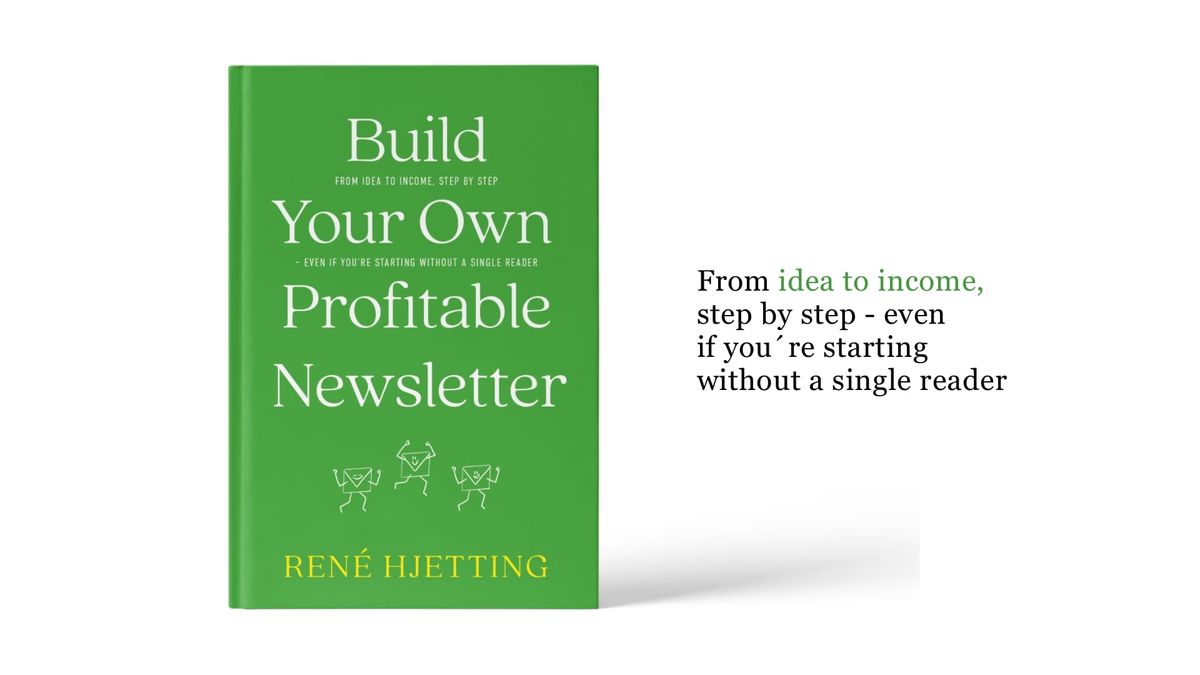
PS. My book Build your own profitable newsletter is currently available for pre-order. If you order it before 1 October, you’ll get access to a newsletter workshop as part of the deal, I’m only running this workshop for those who’ve pre-ordered the book.
 René Hjetting